Q: What is creatine, and how do I take it? Creatine is a naturally occurring compound in muscle that regenerates ATP for short, intense efforts. Take 3–5 g of creatine monohydrate daily, with any meal, every day — no loading phase needed.
What creatine actually is
Creatine is a small molecule made of three amino acids (arginine, glycine, methionine) that your liver and kidneys synthesize and your muscle cells store as phosphocreatine. When you sprint, lift, or jump, phosphocreatine donates a phosphate to ADP to regenerate ATP — the cellular currency of force. More phosphocreatine in your muscles means more reps before fatigue.
It is the single most-studied performance supplement in the world. The International Society of Sports Nutrition position stand (most recent update covers all evidence through 2025) calls it "the most effective ergogenic nutritional supplement currently available to athletes." That is not marketing — that is a peer-reviewed consensus across hundreds of trials.
What creatine does (and does not do)
Documented effects
- Increases muscle phosphocreatine stores by 15–40% over 2–4 weeks
- Improves performance in efforts under 30 seconds (sprints, sets of 5–12 reps, jumps)
- Supports lean mass gain when combined with resistance training
- May support cognitive performance under sleep deprivation (newer research, 2023–2025)
- Helps maintain muscle during a calorie deficit
What creatine does not do
- Does not cause hair loss in healthy adults (the one 2009 study often cited is contested and has not been replicated)
- Does not cause kidney damage in healthy adults — large reviews through 2024 confirm safety at 3–5 g/day for years
- Does not help much for pure endurance efforts over 5 minutes
- Does not require loading. Loading just shortens the saturation timeline from 4 weeks to 1 week.
How to take creatine: the simple protocol
- Dose: 3–5 g per day (5 g if you are over 80 kg)
- Form: creatine monohydrate, micronized if available
- Timing: any time of day, with any meal. Post-workout with carbs is marginally better, but consistency > timing
- Fluid: mix with 200–300 ml water or your post-workout shake
- Frequency: every day, including rest days. Saturation is what works, not single doses.
- Cycling: not needed. Continuous use is safe and effective.
Optional loading protocol
If you want results in week 2 instead of week 4, take 20 g/day split into 4 doses of 5 g for 5–7 days, then drop to 3–5 g/day maintenance. Some users get mild GI upset from loading; if you do, just skip loading and start at 5 g/day.
Creatine monohydrate vs other forms
| Form | Bioavailability | Cost per gram | Verdict |
|---|---|---|---|
| Creatine monohydrate | High | Lowest | The gold standard. 99% of evidence is on this form. |
| Creatine HCl | High (but in lower doses) | 3–5x higher | Smaller scoops, similar effect. Worth it if you bloat on monohydrate. |
| Creapure® micronized monohydrate | High | Slight premium | Patented German source with verified purity testing. |
| Creatine ethyl ester, magnesium chelate, kre-alkalyn | Mixed evidence | Premium | Marketing-heavy; data does not show meaningful superiority. |
| Creatine gummies / chews | Equal to powder (label dose matters) | Higher per gram | Convenient. Check that label dose totals 3–5 g per serving. |
TNF in-stock creatine picks (Canada 2026)
- Allmax Creatine Monohydrate (400 g) — 80 servings of pure monohydrate, the most cost-effective option in our store
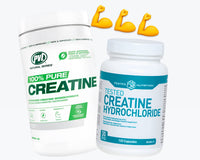
- PVL Pure Pharmaceutical Grade Creatine Monohydrate (300 g) — 60 servings, Canadian-made
- PVL Unflavored Creatine Monohydrate (1000 g) — best per-gram value at TNF
- PEScience TruCreatine+ Creapure® — Creapure-certified for label-accuracy fans
- Bowmar Nutrition Creatine 13 (30 servings) — flavoured version
- Allmax Creatine 3000 (120 capsules) — for travelers who want capsules over powder
- Tested Nutrition Creatine HCl (120 caps) — for users who bloat on monohydrate
- Applied Nutrition Creatine Gummies (80 gummies) and Allmax Creatine Gummies (90 gummies) — gummy convenience format
- PVL Creatine Chewz (80 chewables) — pre-dosed chewables for kids' bag-friendly travel
- Animal Creatine Monohydrate Chews (120 chews) — Animal brand's chew format
Common creatine mistakes Canadians make
- Skipping days — saturation drops with inconsistent dosing
- Loading then quitting in week 2 because "nothing happened" (it takes 4 weeks for full effect at 5 g/day)
- Drinking less water — creatine pulls water into muscle cells. Add 500 ml/day water.
- Buying exotic forms when monohydrate has 99% of the evidence
- Stopping before a cut "to look leaner" — the 1–2 lb water gain is intracellular and looks fuller, not bloated
Will creatine make me bloated or fat?
You gain 1–2 lbs (0.5–1 kg) of intracellular water within 2–4 weeks. That water sits inside muscle cells, not under the skin, so the look is fuller and harder — not puffy. The scale moves up; the mirror looks better. This is desirable for almost every body composition goal.
Can women take creatine?
Yes. There is no biological reason women should avoid creatine. Recent research (2023–2025) shows added benefits for women including bone density support, recovery during the luteal phase, and mood support. Dosing is the same: 3–5 g/day.
Should teens take creatine?
The ISSN position stand notes creatine is safe for adolescent athletes when used as directed. Health Canada permits creatine sales without age restrictions. Many sport-medicine practitioners suggest waiting until age 16, training is consistent, and protein intake from food is dialed in first.
How to tell if your creatine is working
Track these in weeks 2–6:
- Body weight up 0.5–1 kg (water in muscle)
- One extra rep on your top sets at the same load
- Less fatigue on your last few reps
- Faster recovery between sets
Stacking creatine with other supplements
- Whey protein — add creatine to your post-workout shake. See the protein powder selection guide.
- Pre-workout — many formulas include creatine already. If yours does, no extra scoop. See how to mix pre-workout.
- Carbs — taking creatine with 30–50 g carbs raises insulin slightly and improves muscle uptake. Useful, not essential.
- Caffeine — older research suggested caffeine blunts creatine. Newer reviews show no meaningful interaction at normal doses.
For category recommendations see best creatine in Canada and the TNF buying guides hub.
Frequently asked questions
Do I need to load creatine?
No. Loading shortens the saturation timeline from 4 weeks to 1 week. Both work. Most people skip the load and just take 5 g/day.
Should I take creatine before or after my workout?
It does not matter much. Slight edge to post-workout with carbs and protein, but timing is third in importance behind daily consistency and total dose.
Can I take creatine with coffee?
Yes. The old "caffeine blocks creatine" claim came from one 1996 study at very high caffeine doses. Newer reviews show no practical interference.
Will creatine hurt my kidneys?
In healthy adults, no. Long-term studies up to 5 years at 3–10 g/day show no kidney harm. If you have pre-existing kidney disease, consult your doctor.
How long does creatine take to work?
2–4 weeks at 5 g/day, or 1 week with a loading phase. Strength gains follow once saturation is reached.
Should I cycle off creatine?
No. Continuous use is safe and effective. Cycling just resets the 4-week ramp-up.
Are creatine gummies as effective as powder?
Yes, as long as the total daily creatine equals 3–5 g of actual monohydrate. Check the label — some gummies under-dose.
What is the best creatine to buy in Canada?
Any creatine monohydrate from a brand with third-party label testing. At TNF we recommend Allmax Creatine for value, PEScience TruCreatine+ Creapure® for purity certification.
Educational content only; not medical advice. Statements about supplements have not been evaluated by Health Canada.